Posts

Task 4: Spotlight On You: Theatre Through the Ages

Image
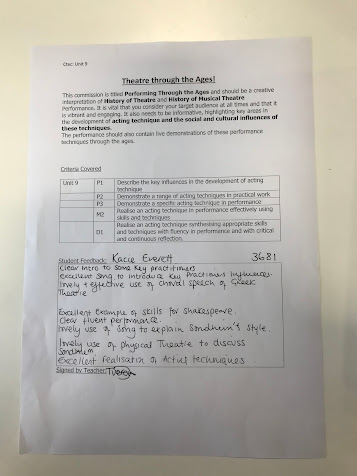
Teacher Feedback  

Task 4: Spotlight On You: Evaluation

  Spotlight On You: Evaluation Strengths Throughout this course, I would say one of my personal strengths was my informative vlogs that I made in relation to Greek Theatre and Commedia Dell’Arte. I think these were strong as I was able to present the information and make it more interesting. These vlogs allowed me to get really involved and invested into these sections of theatre and allowed me to express myself more. These vlogs had scripts that I made and they not only tested my creativity but also my ability to perform my words to make it engaging for an audience. These vlogs opened avenues for me to help to become more confident to try new acting styles. Another thing I think is a strength of mine is that even when I may not be particularly confident or so for able with certain acting styles (Commedia Dell’Arte and Greek theatre) I am still able to fully engage with the acting styles and strongly perform them. I think this was due to the masks as they boosted my confidence....

Task 3: Classical Feature: Handy Theatre Guide

Unit 9 &10 Classical Features Guide

Task 1: Exploring Techniques: Physical Theatre: Frantic Assembly

Image
  Frantic Assembly Classical Theatre Performance What is Physical Theatre? Physical Theatre is a type of theatre where actors use their bodies to portray the emotion I of characters and storylines. Physical theatre is abstract and often conveys hidden metaphors relating to complex social and cultural issues.  WHO ARE FRANTIC ASSEMBLY? H HHHHHHHHHHHHHHHHHH     Background Information Frantic Assembly was founded in 1994 by Scott Graham, Steven Hoggett and Vicki Middleton. The company has developed into one of the UK's most successful theatre companies. The companies ambition  is that they continue to 'Learn and remain committed to making brave and bold theatre'. At times it can be physically brutal and dynamic. Whereas, at other times it's tender and fragile. Frantic Assembly are all about the 'ethos of collaboration, or empowerment, of that constant desire to improve.' They're also about 't elling stories in a voice we don't always hear and about find...
Task 2: A Midsummer Night’s Dream Performance: Performing a Classical Role: Solo Monologue

Image
  Performing a Classical Role Mock 15/12/23 Helena's Monologue: Act 1, Scene 1  From Shakespeare's, 'A Midsummer Night's Dream ' What Went Well? Even Better If?

Task 2: A Midsummer Night’s Dream Performance: Shakespeare Duologue Evaluation and Feedback

  A Midsummer Night’s Dream Performance Evaluation PART ONE 1. What was your initial response to the practitioner Shakespeare? How has this developed/changed during the course of rehearsals and performance? I overall had a very positive initial response to the practitioner Shakespeare. I personally really like the way he uses language in his plays. The hidden meanings of his plays are metaphorically hidden in his scripts and I really enjoy that as it makes audiences think deeper about what he’s writing about in his plays.  I find the language in Shakespeare’s plays rather mesmerising but I knew it would be tricky to learn. As the language is different to modern day language, I knew learning the scripts would be complicated as it is a completely different way of speaking. This is something I was a bit apprehensive about. Shakespeare writes tragedies and comedies and I was hoping that we would be ding one of his comedy plays as they are something that fit my acting style more. I...